Johnny Jackman
Slow BurnJohnny Jackman is presented less through direct action than through the danger other characters attach to his name. A mobster and loan shark linked to Roger MacKenna’s gambling, he becomes the creditor behind a debt of about seven hundred thousand dollars and a reason for Dylan Buchanan to involve federal investigators. His absence from the scenes does not make him remote: the story makes the threat legible through the sums owed, the reputation described by others, and the widening search for him.
Identity and Introduction
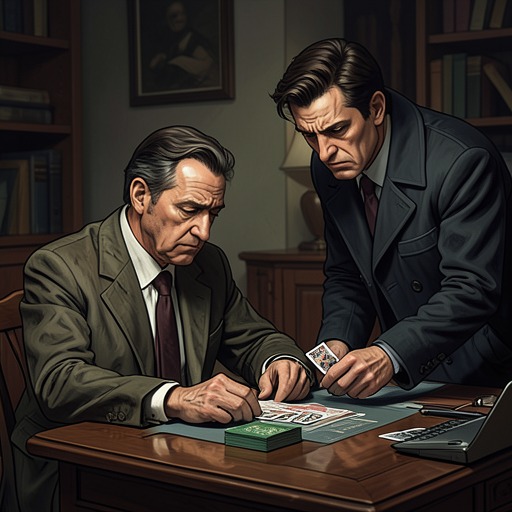
Compton Thomas MacKenna first connects Jackman to the MacKenna family’s decline. While condemning Roger’s gambling, Compton reports that Roger lost more than four hundred thousand dollars in the previous year and had been dealing with mobsters, including Jackman. Compton’s disgust is pointedly about more than money: the MacKenna name, in his view, has been brought into association with a thug. That judgment places Jackman outside the family’s respectable self-image, while also showing how the family’s conduct has made that image vulnerable.
Compton’s account is secondhand. He says his sources tracked Roger and reported on his gambling, so the novel initially establishes Jackman through an investigation into Roger rather than through a meeting or a scene from Jackman’s point of view. The distinction matters: the report identifies a connection and a pattern of loss, but does not show Jackman collecting money or specify what methods he uses. His menace is introduced as a matter of reputation and association, not as a witnessed act.
Debt and Escalating Stakes
Later, Dylan gives Roger’s financial trouble a sharper immediate scale: Roger is in debt to a loan shark for about seven hundred thousand dollars, and that lender is Jackman. The earlier figure of more than four hundred thousand dollars refers to Roger’s reported gambling losses in the previous year; Dylan’s figure concerns the loan-shark debt. Together they mark different aspects of the crisis rather than establishing that the amounts are identical. The narrative moves from a relative’s account of reckless gambling to a present obligation with a named creditor.
Dylan warns that Jackman has connections and a reputation to uphold, and that he will get the money one way or another. The warning turns debt into a practical danger without describing a specific threat or collection attempt. When Kate MacKenna reacts with disbelief at the amount, Dylan insists the lender is the more serious part of the news. The contrast directs attention away from the number alone: the sum matters because Roger owes it to a man Dylan considers capable of enforcing repayment.
Reputation and the Investigation
Dylan also makes clear that his knowledge is not personal. Asked whether he knows Jackman, he says he has never met him but has heard about him. His description therefore functions as an informed warning, not a report of firsthand dealings. He calls Jackman a formidable figure with substantial connections, while the text leaves those connections unspecified. It supplies no organization chart, associates, or account of how Jackman acquired his standing; the uncertainty helps define the limits of what the characters know as well as the threat they perceive.
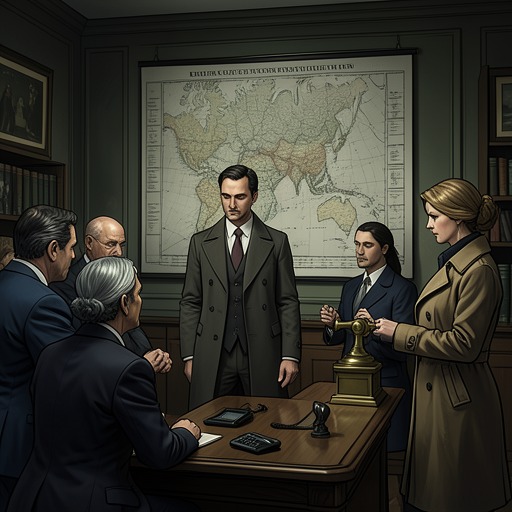
The debt brings the Federal Bureau of Investigation into a pursuit that had already been difficult. Dylan says federal agents have been trying to find grounds against Jackman for a long time and welcomes Roger’s connection as a development that may help them. He argues that Nate Hallinger can no longer keep the federal investigators outside the matter and needs their assistance. The investigation is thus not only about securing Kate’s safety: Jackman’s link to Roger creates an opening in a much longer effort to build a case against him.
Disappearance and Narrative Role
The search remains active but unsettled. Chief Drummond explains that Jackman seems to have vanished from Las Vegas, while Nate is keeping Roger and his two brothers under surveillance. The Federal Bureau of Investigation is searching for Jackman as well as focusing on the bomber, and the overlapping efforts make the local operation feel crowded and difficult to coordinate. Jackman’s disappearance is a reported obstacle, not a resolved escape or proof of what he intends to do next.
Across these references, Jackman serves as the point where Roger’s private vice meets organized criminal danger and public law enforcement. Compton’s account frames the association as a stain on family reputation; Dylan’s warning recasts it as an urgent risk; and the investigators’ search gives it consequences beyond the family. Because Jackman is described rather than encountered, the story keeps his character deliberately bounded by what other people report. What emerges is not a detailed portrait of his private motives, but a consistent role: a feared creditor whose name raises the stakes and whose absence leaves the threat unresolved.